
Scientists pooled 11 studies to find out.
If you’ve ever wondered whether there’s real evidence behind Reiki’s benefits — not just testimonials, but actual clinical data — a 2025 meta-analysis published in Systematic Reviews gives one of the clearest answers yet.
Why this study is worth your attention
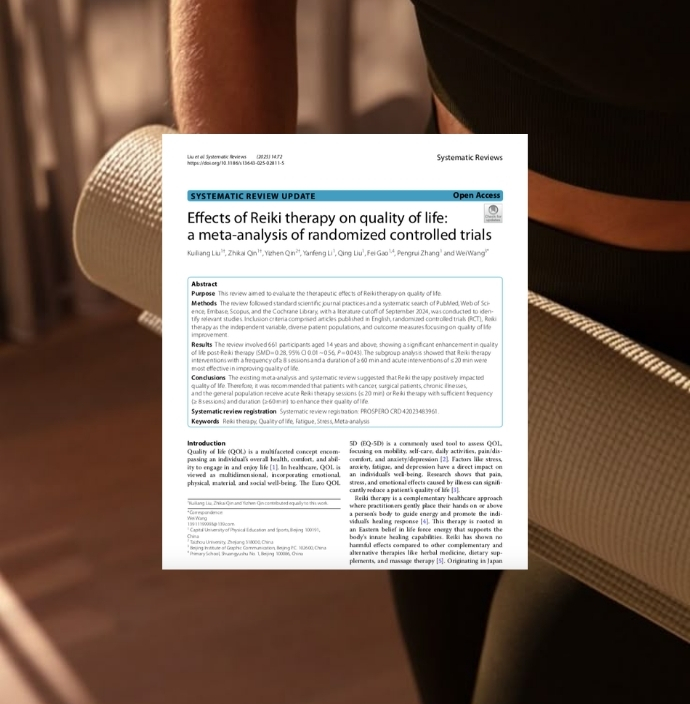
In 2025, a team of researchers published a meta-analysis in the journal Systematic Reviews.
A meta-analysis doesn’t just look at one study. It pools the results from many studies together — in this case, 11 clinical trials with 661 participants — to find patterns that no single experiment could confirm alone.
It’s one of the most reliable forms of scientific evidence we have.
And it looked specifically at one question: does Reiki improve quality of life?
What the research showed
People who received Reiki showed a measurably better quality of life than those who did not receive it.
This was true for cancer patients, people recovering from surgery, people with chronic illness — and also for healthy adults who simply wanted to feel better
- Regular sessions of 60 minutes or more (at least 8 in total) produced the strongest results
- Even short sessions of 20 minutes showed real benefits — imagine what more time could do. My in-person sessions are at least 65 minutes, and distance sessions for adults are at least 30 minutes.
The improvements showed up in the areas that matter most when you're struggling: pain, anxiety, stress, and fatigue.
How the study was conducted
The researchers searched five major scientific databases, looking at studies published up to September 2024.
Only randomized controlled trials were included — the kind where participants are randomly assigned to receive either real Reiki or a control condition.
The review followed international guidelines for systematic research and was registered before the data was collected, to reduce the risk of bias.
In other words: this wasn’t casual. It was rigorous.
What it concludes
Reiki therapy significantly enhanced quality of life across a wide range of people and conditions.
The paper specifically names anxiety, stress, pain, and fatigue as areas where Reiki shows consistent benefit.
The researchers describe Reiki as effective in “alleviating negative states such as anxiety, stress, and pain” — and cite evidence of “reductions in stress, anxiety, and pain scores” across multiple patient groups. They also identify fatigue as a key outcome, noting that “chronic disease-related fatigue could potentially impact overall quality of life” and that Reiki addresses this directly.
The researchers specifically recommend it for people with cancer, those recovering from surgery, people managing chronic conditions — and anyone in the general population who wants to feel more like themselves again.
What this might mean for you
You don’t need a diagnosis for Reiki to be relevant to you.
If stress, anxiety, exhaustion, or pain have been quietly shrinking your world — this research suggests that regular Reiki sessions can help shift that. Not overnight. Not magically. But measurably.
What the research doesn't yet tell us
The authors point out that blinding is genuinely difficult in Reiki studies — a practitioner always knows whether they’ve been trained, which can influence results in subtle ways.
The effect measured was real, but modest. Reiki isn’t a replacement for medical care.
And because quality of life is shaped by so many factors — sleep, relationships, work, health — more large-scale studies are still needed to understand exactly how and when Reiki helps most.
That honesty matters. Good science asks more questions than it answers.
REFERENCE:
Effects of Reiki therapy on quality of life: a meta-analysis of randomized controlled trials
by Kuiliang Liu, Zhikai Qin, Yizhen Qin, Yanfeng Li, Qing Liu, Fei Gao, Pengrui Zhang & Wei Wang
Take the next step
If something in this resonated, your body might already be telling you something.
Want to keep reading first?
The next post tackles the question skeptics ask most: is Reiki just a placebo? (coming soon)