
13 controlled studies say otherwise.
Is Reiki actually doing something — or is it just a placebo effect? A 2017 review in the Journal of Evidence-Based Complementary & Alternative Medicine examined 13 controlled studies to find out. The answer was yes.
Why this research matters
The placebo effect is real. Any honest look at Reiki has to account for it.
What is a placebo?
A placebo is a fake treatment that looks and feels real — like a sugar pill instead of actual medicine.
Sometimes people feel better just because they believe they’re being treated. That’s the placebo effect. It’s real, it’s powerful, and it has to be ruled out in any serious study.
Researcher David McManus focused only on studies that used “sham Reiki” — where an actor mimicked every hand position and movement of a trained Reiki practitioner, without having received an attunement.
This is the most rigorous way to test whether Reiki itself is producing results, or whether it’s simply the warmth of someone’s presence.
What is sham Reiki and why is it used?
Sham Reiki is a fake version of Reiki performed by someone who has not been attuned.
They copy every hand position and movement of a real practitioner — but without the training.
It’s used in studies to test whether it’s the Reiki itself making a difference, or simply the experience of someone being present and attentive.
What the research found
- 13 controlled studies were reviewed
- 8 of those 13 showed Reiki was more effective than sham placebo
- 4 showed no significant difference — but likely because the studies weren’t large enough to detect one, not because Reiki didn’t work
- Only 1 study found clear evidence of no benefit — and in that study, even the placebo had no effect
Beyond self-reported feelings, the studies measured real physical changes in people who received Reiki:
Lower resting heart rate. Lower blood pressure. Increased heart rate variability.
These are objective measurements.
They happen in the body, not just in perception.
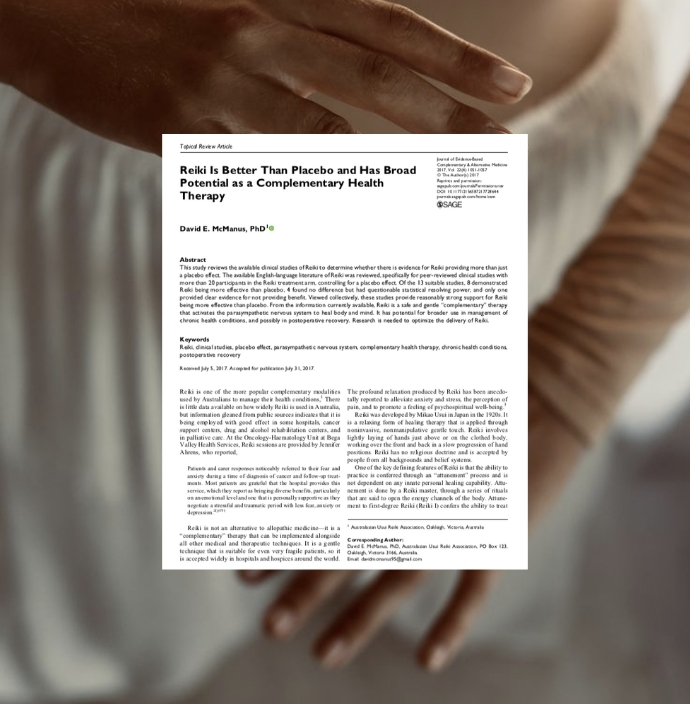
How the study was conducted
McManus searched the scientific literature over more than three months, cross-referencing every study he found.
To be included, a study had to be published in a peer-reviewed journal, use a sham Reiki placebo group, and include at least 20 participants receiving Reiki.
Two studies using laboratory rats were also included — because rats cannot experience a placebo effect. Their physiological results were just as significant.
What it concludes
The review provides strong support for Reiki being more effective than placebo.
The proposed reason is physiological.
Reiki appears to activate the parasympathetic nervous system — the part of your nervous system responsible for rest, recovery, and healing.
This happens via the vagus nerve, which regulates stress hormones, inflammation, pain perception, and emotional balance.
Put simply:
Reiki appears to shift your body out of stress mode and into recovery mode.
What this might mean for you
If your nervous system has been running on high alert — and for many people right now, it has — this matters.
The changes documented in these studies aren’t subtle feelings. They’re measurable physiological shifts. Lower heart rate. Lower blood pressure. A body beginning to remember how to rest.
That’s not nothing. That’s exactly what a burned-out system needs.
What the research doesn't yet tell us
Transparency matters here.
The author of this review, David McManus, is affiliated with the Australasian Usui Reiki Association — which is worth knowing, even though the studies he reviewed were all independently peer-reviewed.
The studies reviewed included both pilot studies and clinical trials of varying sizes. And the optimal number of sessions, their ideal length, and the best approach for specific conditions is still being researched.
More independent, large-scale studies are needed. The science is promising — and it’s still growing.
REFERENCE:
Reiki Is Better Than Placebo and Has Broad Potential as a Complementary Health Therapy
by David E McManus, PhD
Take the next step
Your nervous system deserves a break.
Book your first Reiki session here
Want keep reading?
Check out the testimonials here, where more than 25 of my clients share their experience with Reiki.