
What the research found.
Does Reiki actually change how people feel — or is it just a nice way to relax for an hour?
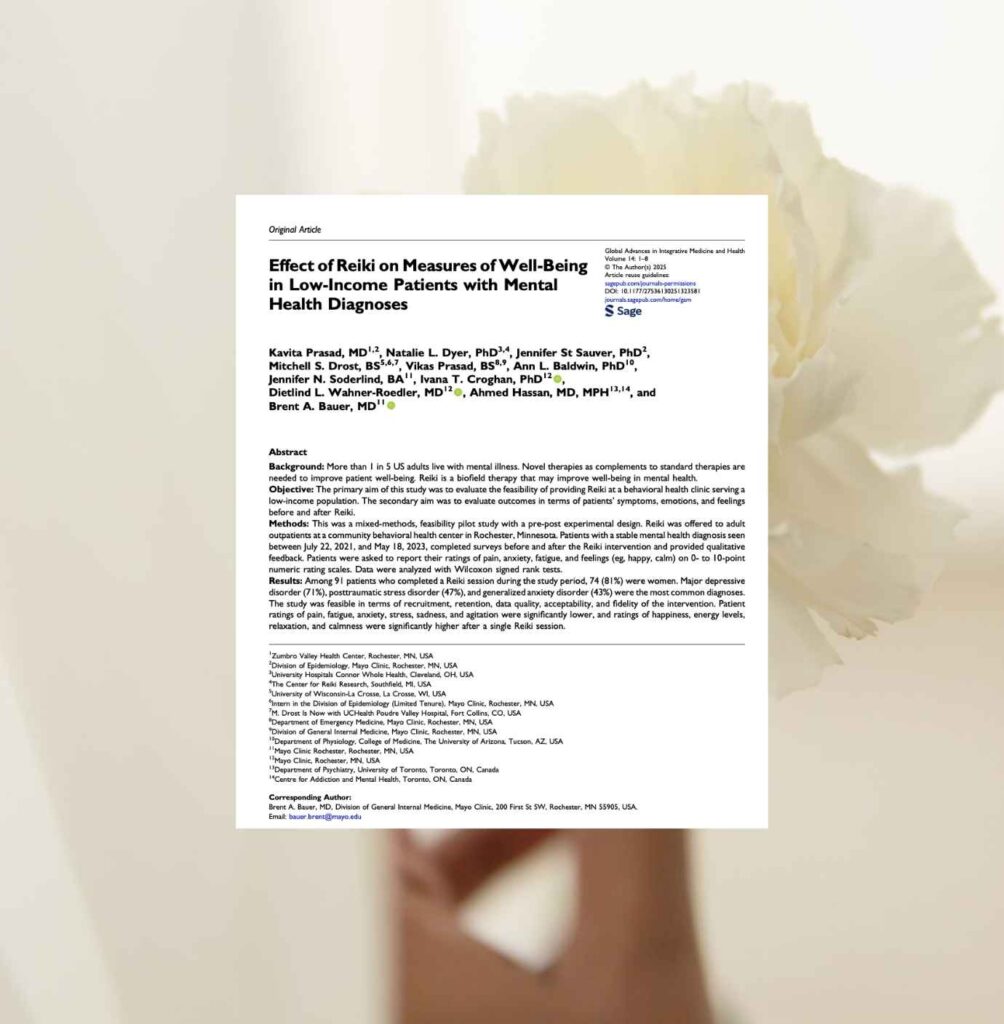
A 2025 study published in Global Advances in Integrative Medicine and Health looked at 91 patients with diagnoses like depression, PTSD, and generalized anxiety disorder.
After a single Reiki session, their reported stress, anxiety, and pain dropped significantly. Feelings of calm and happiness rose.
Why this study matters
If you live with anxiety, depression, or chronic stress, you’ve probably wondered whether therapies like Reiki are backed by anything beyond anecdote.
This study looked specifically at people managing real mental health diagnoses, not a general wellness crowd. That makes the results more relevant if you’re weighing Reiki as a complement to your own care.
What the research found
- After one session, patients reported significantly less pain, fatigue, anxiety, stress, sadness, and agitation.
- Feelings of happiness, energy, relaxation, and calm all increased significantly. Relaxation and calm showed the biggest jumps.
- Among negative emotions, stress, anxiety, and sadness dropped the most.
How the study was conducted
Researchers worked with 91 outpatients at a behavioral health clinic in Minnesota.
All had a stable mental health diagnosis, most often major depression, PTSD, or generalized anxiety disorder.
Each patient rated their pain, anxiety, stress, and mood on a 0-10 scale before and after a single 60-minute Reiki session.
There was no control group. Everyone in the study received Reiki, and their own before-and-after scores were compared.
What it concludes
The researchers concluded that Reiki was feasible to offer inside a behavioral health clinic, fitting easily into the regular flow of care, and that patients found it acceptable and safe.
No adverse effects were reported.
In the study’s own words, Reiki “improved positive emotions and feelings and decreased negative measures.”
Patients described the sessions in their own words too.
One wrote,
"Reiki helps me relax and let go of all the stress that is in my life."
Another said,
"Reiki allows me to relax and release anxiety."
What this could mean for you
If you’re navigating stress, anxiety, or a mental health diagnosis, this study suggests a single Reiki session may offer real, immediate relief in how you feel.
It’s not a replacement for your therapy, medication, or medical care. It may be a supportive addition alongside it.
From my point of view:
A single Reiki session doesn’t resolve or cure a diagnosis like anxiety, depression, or PTSD. It offers relief in the moment, but healing takes several sessions and consistency. And even so, we can never promise concrete results with Reiki.
The study only measured the effect of a single session. In my own practice, I’ve seen that one session tends to bring relief that lasts a day or two.
For people managing an ongoing diagnosis like anxiety, depression, or PTSD, I recommend at least 8 sessions, ideally 10 to 15, and more if possible.
In my experience, that’s where the effects start to build and last longer.
Everyone’s healing process is unique, so this isn’t a fixed rule, but it’s a pattern I’ve seen consistently.
Keep in mind that Reiki doesn’t replace medical, psychological, or psychiatric care, but it can complement it. I also want to stress that we can’t promise specific results.
An important clarification
This study didn’t include a control group, so we can’t know how much of the improvement came from Reiki itself versus simply resting in a calm space with someone’s full attention for an hour.
Fortunately, two other studies back this up: one shows that Reiki isn’t just a placebo effect, but has real physical effects on the body, and another confirms that Reiki has a real effect on quality of life.
The researchers also used simple 0-10 rating scales rather than clinically validated tools, and there’s no data yet on whether the benefits last beyond the session.
From my perspective, studies like this matter, not because they prove Reiki “works” in a strict clinical sense, but because they start building the kind of evidence that lets people make informed choices about complementary care.
REFERENCE:
Effect of Reiki on Measures of Well-Being in Low-Income Patients with Mental Health Diagnoses
Authors:
Kavita Prasad, MD, Natalie L. Dyer, PhD, Jennifer St Sauver, PhD, Mitchell S. Drost, BS, Vikas Prasad, BS, Ann L. Baldwin, PhD, Jennifer N. Soderlind, BA, Ivana T. Croghan, PhD, Dietlind L. Wahner-Roedler, MD, Ahmed Hassan, MD, MPH, y Brent A. Bauer, MD
Published in:
Global Advances in Integrative Medicine and Health, Vol. 14, 2025
Take the next step
Curious what a Reiki session actually feels like?
Book a session with me in Providencia or online, and find out for yourself.
Disclosure: one of the study’s co-authors had his time on this research partly funded by the HEAD Foundation (Singapore). The study itself received no dedicated funding, and the remaining authors declared no conflicts of interest.